
KSeF 2026: what companies must change in invoicing (and how to prepare without chaos)
15 MIN READ
In the article you will learn:
- from 1.2.2026 mandatory for large companies, from 1.4.2026 for all
- KSeF is a process change, not just integration
- without clear roles, chaos will arise
- the checklist below will help prepare the company
KSeF (Krajowy System e-Faktur) represents a fundamental change in the way invoicing is done in Poland. An e-invoice is no longer a “PDF sent by email” and is becoming a structured data document that is sent and received through the state system.
For companies with custom business (agencies, consulting companies, IT services, etc.), it is not primarily a technical project, but a process change: who prepares the documents, who approves, how is data quality monitored and how to ensure smooth cash flow.
In the article you will find an overview of the obligations in 2026 and a specific step-by-step checklist that you can use as an internal plan.
What is KSeF – and why it’s not just “another integration”
KSeF unifies the way invoices are issued and transmitted in Poland. Each invoice has a prescribed structure (e.g. FA(3) schema) and is sent to the system as structured data.
In reality, this means:
- Data quality is more important than the appearance of the invoice. Missing or incorrect data has a direct impact on the invoice’s passage through the system.
- A sent invoice cannot be modified retroactively. Once an invoice has been sent to KSeF, any changes can only be made by issuing a corrective invoice.
- New operational questions arise. Who is authorized to send? How are approvals set up? How does the audit trail work?
- The process can be significantly accelerated – if set up correctly. Companies that set up the process, roles and responsibilities systematically can gain greater financial clarity and a faster flow of invoices.
When is KSeF mandatory: dates for 2026
From 1. 2. 2026
The obligation to send invoices via KSeF arises for companies that had a turnover of over PLN 200 million (including VAT) in 2024.
Receiving invoices via KSeF is mandatory for all companies from this date.
From 1. 4. 2026
The obligation to issue invoices via KSeF extends to all companies and invoice issuers, with the exception of the smallest entities whose monthly invoice value does not exceed PLN 10,000.
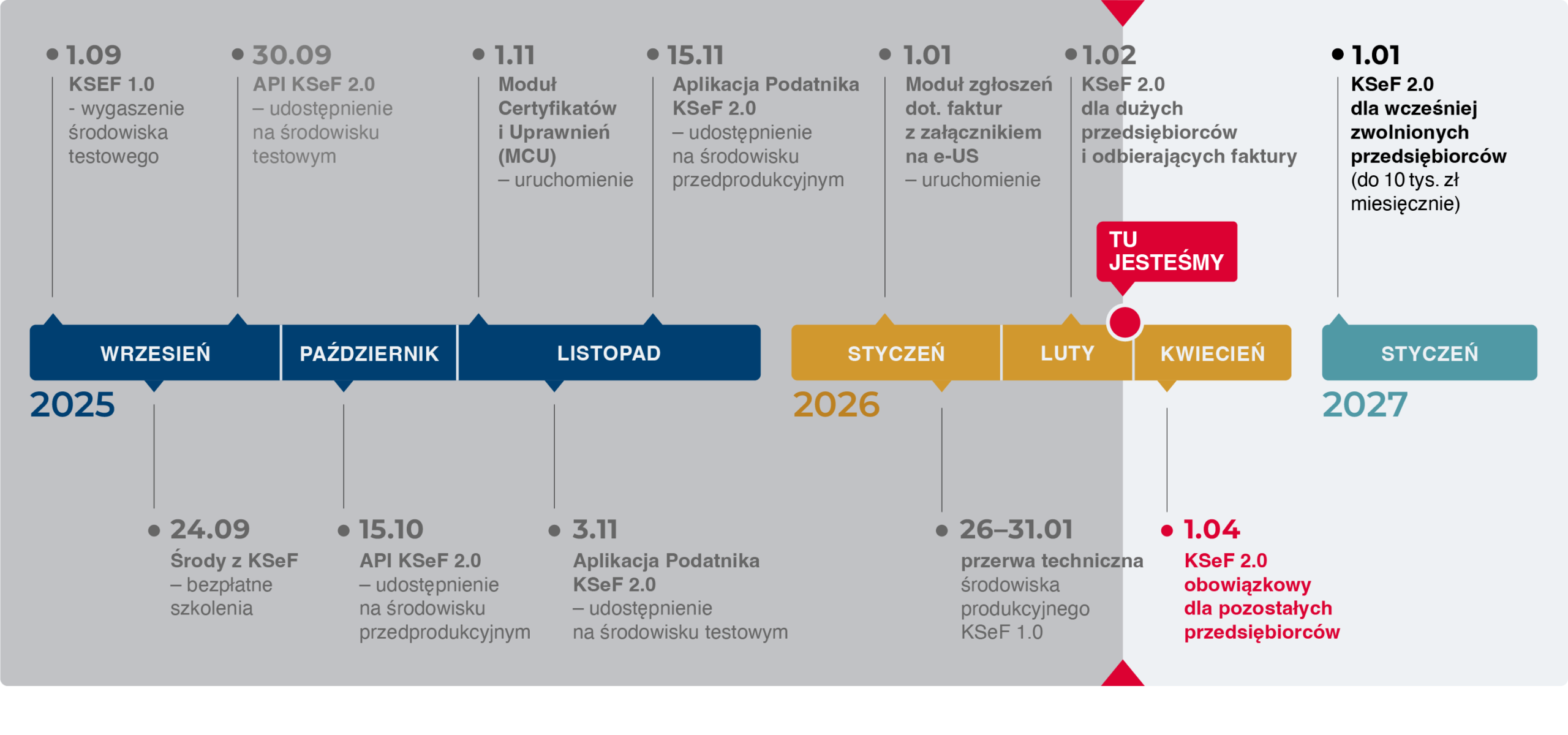
Note: In addition to the above cases, there are also selected exceptions and specific conditions stipulated by legislation. Details can be found on the official KSeF portal:
https://ksef.podatki.gov.pl/informacje-ogolne-ksef-20/zakres-obowiazkowego-ksef
The most common blind spots that only "hurt" companies during peak hours
In practice, we see several typical ambiguities in companies that become fully apparent only when KSeF is running in production.
1. “We don’t have an owner”
No one has clear responsibility for KSeF as a whole. Often, the agenda falls under finance, technical connections are handled by IT, but there is no one to manage the implementation across the company – processes, roles, permissions and process changes.
KSeF has both technical and business impacts. Without a clear owner, unnecessary gaps in responsibilities and decision-making arise.
2. Approval is ad hoc
Issued invoices and received invoices are approved “when the time comes”. KSeF will simplify the receipt and sending of invoices for those companies that are prepared and have clearly set processes.
However, if approval works haphazardly, KSeF will not solve the chaos – it will only make it visible. Invoices start piling up, it is not clear who should assign them to orders or overheads, who should approve them and when they should be transferred to accounting.
3. The data is “okay in PDF”, but the reality shows up in the structured invoice
A PDF invoice may look correct. However, in a structured form for KSeF, it is immediately clear whether the data is really clean and prepared. It is not just about the appearance of the document, but about the quality of the data:
- a correctly registered client / supplier and all related data,
- correct VAT rates on individual items,
- clearly defined items and units,
- correct assignment to the order
With services, it is even more sensitive – if the documents are not systematically prepared, this will be reflected when sending them to KSeF. In a structured invoice, there is no room for improvisation. KSeF requires that the data be correct, consistent and prepared before sending.
4. Cash flow shortfalls due to unclear procedures
A poorly set up invoice sending process can have a direct impact on cash flow. If it is not clear:
- who issues the invoice and based on what documents,
- who approves it,
- who sends it to KSeF,
it may happen that the invoice will not be sent on time. And if the invoice is not in KSeF, the customer cannot book it – and payment is delayed. For companies with a larger volume of orders, this can mean significant financial shortfalls.
Practical preparation checklist: 13 steps (for managers, not developers)
1) People and responsibilities
1. Appoint a KSeF owner
Ideally a business role (CFO, COO, Head of Operations) who will be responsible for the process as a whole – not just for the technical connection.
2. Write down roles and permissions
- Who issues invoices?
Who approves them?
Who sends them to KSeF and at what point?
Who is responsible for received invoices
At the same time, review the current approval and, if possible, digitize the process.
3. Set up substitutions
The departure or temporary absence of a key person must not mean that the company “cannot invoice”.
2) Data and sources of truth
4. Map where the invoice data originates.
CRM? Project system? Timesheets? Accounting? It must be clear where the “source of truth” is.
5. Define critical fields and their guarantors.
For example:
- Counterparty (client / supplier) and related data (name, NIP, address, …)
- VAT rates
- Item structure
Each field should have a clear owner responsible for its accuracy.
6. Clarify the origin of items.
From what sources do the amounts on the invoice originate? Budget, milestone, timesheet?
The process must be consistent.
7. Set up basic validations before sending.
Check NIP, VAT rates and mandatory fields.
3) Workflow (this is where you save the most time and errors)
KSeF is an ideal opportunity to stop and set up approval processes systematically. Companies that view it only as a “technical obligation” will miss the chance to simplify and streamline the process.
8. Received invoices
The standard should look like this: receipt of an invoice from KSeF → assignment to a project or overhead → check by the responsible person → approval → transfer to accounting.
The key is:
- to make it clear who receives the invoice,
- who assigns it to the order,
- who approves it,
- and at what time it should be processed.
Ad hoc approval (“when there is time”) leads to delays, accumulation of invoices and inaccuracies in project costs.
However, a properly set process has another fundamental benefit: already approved and clean data, enriched with useful metadata – for example, the client, order, order item or prepared preliminary invoice, then enters the accounting system. Accounting does not deal with context search, but works with complete information.
9. Issued invoices
For issued invoices, the process should be equally clear: documents → data check → approval → sending to KSeF → status monitoring.
It is important to answer:
- Who guarantees the accuracy of the documents?
- From what source do we compile the invoice? (CRM system, approved budget, …)
- Who checks the formal requirements?
- Who actually sends the invoice to KSeF?
- Who monitors whether it has been received and has been assigned a KSeF ID?
The moment the invoice enters KSeF, there is no room for improvisation.
10. Approval process and rules
Now is the right time to set up:
- a clear approval process and matrix by amount or document type,
- SLA (time limit for approval),
- overview of authorizations (who can issue, who approves, who sends),
- and substitutability of key roles.
A properly set up process provides an immediate overview: it is clear which documents are approved, which are waiting for approval, who is waiting for them and why. Each invoice has its own status and responsibility. Instead of searching through emails and spreadsheets, a transparent and controlled document flow is created.
4) Operation and continuity
11. Define “stop states”.
What happens if an invoice does not go through the system? Or does it go through, but with incorrect data (e.g. the wrong amount)? Who corrects the data? Who communicates with the customer or supplier?
12. Test typical scenarios.
Try at least:
- 5 common issued invoices
- 5 common received invoices
- proforma and correction invoices
- Don’t just deal with ideal cases.
13. Training and internal communication
You don’t need an extensive manual or several days of training. A simple, understandable one-pager and a short (e.g. 30-minute) meeting for project managers and finance is enough.
It is important that everyone knows:
- what is changing compared to the current method of invoicing,
- who is responsible for what,
- what is the procedure in a normal situation,
- and what to do if an invoice gets “stuck”.
KSeF is a process change. If people understand the new document flow and their roles, the adaptation will go smoothly. If not, uncertainty, delays, and unnecessary errors will arise.
When is integration enough and when do you need a unified system (orders + finances + workflow)?
Not every company needs a comprehensive solution. For some companies, simple KSeF integration or invoicing and connection to KSeF directly from the accounting system is fully sufficient.
When is simple integration or KSeF directly from accounting sufficient
A simple solution usually makes sense if:
- you issue simple invoices without a complex item structure,
- approval is minimal or is carried out by one person,
- the data for the invoice is created in a single source and is consistent,
- there is no need for detailed allocation of costs to specific orders.
In such a case, connection directly from accounting may be fully sufficient.
When does a unified system make sense (orders + finances + workflow + KSeF)
If at least three of the following apply, it is more appropriate to handle invoicing in a unified system. It makes sense when 3 or more of the following apply:
- you have multiple approvers and rules based on the amount or type of document,
- you invoice according to the approved budget, time worked, milestones or combined models,
- you re-invoice costs to clients,
- you need to continuously monitor the margin of orders,
- you often search for documents and copy data between systems,
- you solve the link between order, budget and invoicing.
In these situations, KSeF is not just an “invoice sending channel”, but part of broader financial management.
Teamogy as one unified system with full connection to KSeF
When implementing KSeF, companies often choose a solution that adds another layer to their existing architecture – a standalone integrator, an accounting add-on, or manual intermediate steps between systems. While such an approach may meet the requirement in the short term, it increases complexity, the number of control points, and the risk of errors in the long term.
It is more sustainable to build the process on one main system, in which:
- invoicing data is generated,
- it is checked and approved,
- costs, budgets, and margins are tracked,
- and KSeF is a natural input (received invoices) and output channel (issued invoices).
Teamogy has an integration to KSeF directly as part of the system. Therefore, there is no need to assemble a solution from several tools – orders, budgets, costs, approvals, and invoicing run in one environment, and sending an e-invoice to KSeF is the logical conclusion of the entire process.
In practice, this means:
- less manual work and data rewriting,
- less errors caused by inconsistencies between systems,
- clearly defined roles and responsibilities,
- a transparent overview of the status of invoices,
- and the ability to manage custom business (work in progress, profitability) systematically, not haphazardly.
The entire process also naturally fits into the company’s financial management. After internal approval, invoices are prepared as clean, complete and context-enriched data for accounting – ideally with the option of their automatic posting, without manual rewriting between systems.
If the company is to operate effectively in the long term, it is more advantageous to build the process on a single system that covers the entire flow from the project to the posted invoice. In such a setup, KSeF does not add any further complication – it simply fits into an already managed and controlled process.

ROBERT SZELENBAUM
Country manager, poland
Mohlo by Vás ještě zajímat

Microsoft Teams vs Teamogy
Microsoft Teams is great for chat. But for companies working on client projects, traceability and connection to projects, tasks, and documents are crucial. Teamogy solves that.

How to Create a Truly Secure Password
Let’s take a closer look at how to ensure your data remains properly password-protected and cannot be misused to harm your organization.

Marco BBN uses Teamogy daily for a real-time overview of the agency.
This year marks 30 years since the brothers Pavel and Petr Marek founded the Marco BBN agency, a relatively unique agency on the Czech market, as its specializations include, among other things, B2B marketing, which has many specifics.
We talked to one of the agency’s founders and its Managing Director Pavel Marek about marketing know-how for B2B clients, interesting case studies, and how membership in the BBN network or the daily use of the Teamogy system helps the agency. And we looked a bit into the near future.

Long-term cooperation with AETNA agency
Jakub Žirovnický, CEO of the strategic-creative agency AETNA, gave us the interview we were looking forward to.
Jakub talked to Libor about the projects that are the most common and typical for their agency and also about the role of Teamogy in the daily operation of the agency.
Sophisticated Teamogy localization
Teamogy is becoming an essential everyday tool in companies around the world. Why is it successful in getting clients in many countries? And what exactly does tailoring a system to a particular market look like?

A better overview of the company’s finances
The new version Teamogy 3.10 will provide you and your team with even greater financial control through bank statement processing. Additionally, Teamogy will simplify the creation of client budgets with predefined price list items and many other enhancements.

Company’s resolutions for the next year
What about a company’s goals for the new year? The Teamogy system can help you fulfill your company resolutions and goals.

Teamogy makes our lives easier
BLOGMFA Studio ProjectTeamogy makes our lives easierMALGORZATA SZELENBAUM10 MIN READWe spoke with Grzegorz Szymczak, CEO and chief architect at MFA Studio, about the daily work of an architect, which consists not only of design but also of organizational tasks, and...

Interiors with love …and with overview.
The team of architects, planners and interior designers from Premiers interiors have been creating interiors with love for 5 years and have already completed more than 100 projects. We chatted with Patrick Cirbus, COO of Premier Interiors about the projects, working with clients and also what Teamogy has brought to the company on a daily basis.
Nenechte si ujít zajímavé články a tipy
Chcete-li být mezi prvními, zadejte prosím Váš e-mail. Budeme se snažit posílat vždy kvalitní a pro vás zajímavý obsah.